A production line can have plenty of labor and still struggle to sort consistently. Manual inspection depends on operator attention, pace, and judgment, while automated equipment applies programmed sorting rules to every item.
The real difference is not simply whether a machine replaces people. It is how each method controls throughput, weight classification, consistency, and process data.
For food processors handling seafood, meat, poultry, fruit, vegetables, or prepared foods, the choice becomes practical when product volumes rise or weight categories become tighter.
Easyweigh provides automated weighing and sorting equipment designed for these production environments, including systems with high-precision sensors, customizable parameters, and real-time monitoring. The comparison below focuses on where manual sorting and automation differ in daily operation.
The Sorting Decision Changes Once Product Volume Becomes the Constraint
Manual sorting can work when volumes are modest and product characteristics are easy to judge. Operators can visually inspect items, pick products, and place them into different groups without installing a dedicated line. That flexibility can be useful for short runs, variable products, or operations where sorting criteria change frequently.
Capacity becomes harder to control as production increases. Human operators must maintain a working pace throughout the shift, and output is tied directly to available labor. A sorting machine, by contrast, can perform weighing and classification continuously as products move through the line.
Manual Judgment and Sensor-Based Classification Produce Different Results
Human sorting relies on perception. An operator may identify obvious size, appearance, or weight differences, but borderline items can be difficult to classify consistently. Fatigue, distraction, and differences between workers can also introduce variation.
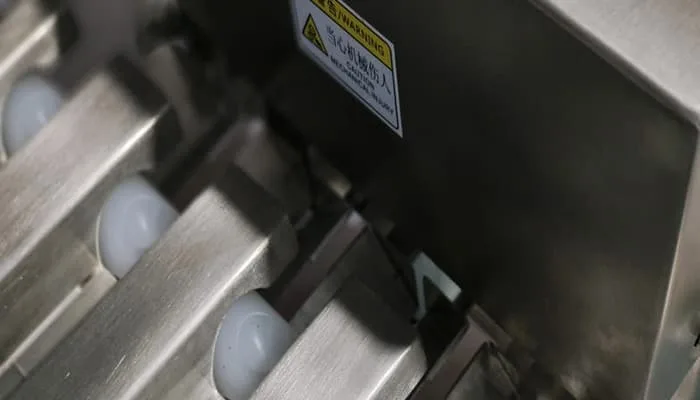
Automated Weight Sorting uses high-precision sensors to measure products and assign them to predefined weight categories. The system can be configured for multiple sorting groups, making the classification rule repeatable from one product to the next.
That distinction matters when uniform portions or defined weight classes are central to production. A programmed threshold does not change because one operator is faster than another.
Labor Does More Than Sort: It Also Determines Line Stability
Manual sorting creates a direct relationship between staffing and output. More volume may require more operators, while absenteeism or turnover can affect line capacity. Training also matters because workers must understand product categories and sorting rules.
Automation shifts much of that repetitive work to equipment. Operators remain necessary for line operation, product handling, inspection, cleaning, and process supervision, but the repetitive classification task becomes machine-controlled. This can make labor deployment less dependent on continuous manual picking and weighing.
What Happens to Accuracy When Weight Becomes a Production Variable?
Manual sorting is not inherently inaccurate. Skilled operators can make useful decisions, particularly when the classification criteria are broad. The limitation appears when every item must be judged against narrow or measurable weight ranges.
Weight Sorting equipment measures weight directly rather than estimating it visually. Published specifications for several Weight Sorting models show checking ranges up to 3,000g or 5,000g and stated accuracy ranges of ±1g to ±5g, depending on the model. A small‑range rotating‑tray model is listed with ±0.3 g nominal accuracy. Note: Higher precision such as ±0.3 g applies only to small‑capacity rotating‑tray variants. Real‑world dynamic performance is subject to product characteristics and production‑line conditions. These figures are model-specific and should not be treated as universal machine performance.
For a processor, the important question is whether the selected machine matches the product, target weight ranges, required throughput, and handling method. Automation creates repeatable measurement, but correct machine selection still determines whether that repeatability is useful.
Sorting Machines Also Change What the Production Team Can Monitor
Manual sorting produces limited process data unless workers record results separately. Managers may know how many products were sorted, but obtaining detailed weight distributions or production trends can require additional measurement and paperwork.
Automated systems can provide a more connected view of the process. The referenced equipment includes real-time monitoring and data analytics, while customizable sorting parameters can be adjusted for different production requirements.
Which Method Fits a Specific Processing Line?
Manual sorting remains reasonable where production is small, sorting rules are simple, and flexibility matters more than continuous throughput. It may also serve during product trials or before a line reaches the volume that justifies automation.
Automation becomes more compelling when the line needs repeatable weight classification, higher throughput, multiple sorting categories, or closer process monitoring. Easyweigh systems are positioned for food processing, agriculture, and manufacturing, with configurations covering products such as seafood, fish, meat, poultry, fruits, vegetables, and prepared foods.
The decision should begin with the production requirement rather than the technology label. Product weight range, line speed, number of categories, product handling characteristics, available labor, and integration requirements provide a more useful basis for comparison than simply asking whether a machine is faster.
Choosing Between Labor Flexibility and Automated Consistency
Manual sorting offers simplicity and human adaptability, but its capacity and consistency are closely linked to the workforce. Automated sorting replaces much of the repetitive judgment with measured, programmable classification and can connect sorting with monitoring and line control.
Easyweigh’s equipment demonstrates how weight-based automation can be configured around different products and processing formats. For manufacturers moving from labor-intensive sorting toward a more controlled production flow, the strongest case for automation is not speed alone. It is the combination of repeatable classification, scalable operation, and better visibility into what happens on the line.