Small-vessel PCI creates a demanding procurement question: how can buyers compare balloon products when the available working space is limited and lesion preparation may require careful device selection? Small-vessel coronary disease is commonly discussed using vessel diameters below 3 mm, although definitions vary across studies. The smaller lumen also means that relatively small changes in tissue or residual stenosis can have greater implications for the final vessel lumen.
For hospitals, distributors, and medical-device procurement teams, choosing a coronary balloon supplier should therefore involve more than checking price and product availability. Buyers need to examine balloon design, lesion-preparation capabilities, model selection, documentation, and the supplier’s ability to support different procedural requirements.
Why Small Vessel PCI Requires Careful Balloon Selection
Small-vessel intervention can present different technical considerations from treatment in larger coronary arteries. Published reviews note that small-vessel disease has been associated with a higher risk of restenosis after PCI, while the definition of “small vessel” itself differs between studies.
This makes product selection particularly important for procurement teams. A balloon can not be selected simply because its nominal diameter appears appropriate. Buyers should also consider whether the device’s construction, crossing characteristics, pressure performance, and available configurations correspond with the intended application.
For suppliers, this means technical documentation should explain the product’s intended role in coronary lesion preparation and clearly identify the available models and sizes rather than implying that one balloon is appropriate for every small-vessel intervention.”
What Design Features Should Buyers Examine?
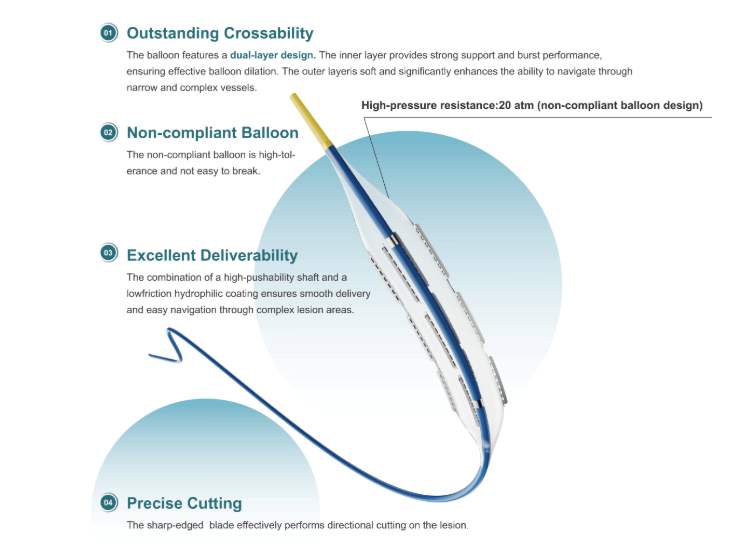
A cutting balloon differs from conventional balloon dilatation catheters by incorporating micro-blades into the balloon surface to provide controlled directional scoring during lesion expansion. Advanced cutting balloons feature non-compliant balloon materials, high-load-bearing blade mounting, and precision-honed sharp blade edges. This construction enables uniform force distribution across resistant atheromatous plaques without requiring excessive inflation pressures.
Evaluating structural blade integration provides procurement teams with concrete metrics for device comparison across candidate suppliers. Rather than relying on generic performance claims like small-vessel suitability, purchasing managers can analyze available balloon diameters, working lengths, blade configurations, and pressure ratings. Having detailed dimensional specifications allows buyers to match product portfolios with the exact anatomical requirements of target healthcare markets.
Coronary arterial navigation requires cutting balloons to negotiate severe bends and tortuous vessel pathways without compromising structural integrity or losing blade stability. Specialized designs incorporate split-blade structures that allow the catheter to flex naturally around acute bends. Combining split micro-blades with hidden folding technology significantly reduces outer crossing profile, allowing the assembly to pass through calcified stenoses smoothly.
Distal catheter assembly performance depends on small-diameter tapered tip heads and durable hydrophilic surface coatings that minimize frictional resistance against vessel walls. These concrete mechanical attributes allow clinical distributors and hospital purchasing teams to conduct objective technical evaluations. Discussing verified structural specifications ensures transparent communication regarding catheter navigation, crossability, and trackability without relying on unsupported clinical marketing claims.
What Should a Coronary Balloon Supplier Document?
A reliable medical device supplier must provide a comprehensive technical information package rather than relying on basic product naming. Procurement teams should systematically evaluate precise dimensional parameters, including available balloon diameters, working lengths, shaft dimensions, catheter configurations, and marker setups. Assessing these detailed mechanical attributes ensures seamless procedural compatibility and equipment integration across clinical catheterization laboratories.
Furthermore, technical packages must specify guidewire compatibility, recommended guiding-catheter sizing, nominal inflation pressures, and rated burst pressure thresholds. Verifying exact specifications against current regulatory documentation and official data sheets is essential for international distributors preparing market registration files, submitting hospital tender dossiers, or conducting data-driven product comparisons across competing device manufacturers.
Explain the Intended Product Role
Small-vessel PCI does not rely on one balloon technology for every lesion. Contemporary literature discusses conventional balloon angioplasty, drug-coated balloons, drug-eluting stents, and cutting-balloon strategies among the available approaches, with device selection depending on lesion and procedural circumstances.
Therefore, a supplier should explain the intended role of its product instead of implying that one catheter is appropriate for every small-vessel intervention.
Evaluating the Broader Product Portfolio
When reviewing coronary cutting balloon options, buyers may also benefit from examining the supplier’s wider coronary-intervention portfolio. Shunmei’s coronary product range includes coronary IVL catheters, coronary microcatheters, guide extension catheters, double-lumen catheters, balloon dilatation catheters, guidewires, guiding catheters, angiographic catheters, drug-coated balloon dilatation catheters, and coronary drug-eluting stents.
For distributors, broader portfolio coverage can simplify supplier evaluation when multiple device categories are required. However, portfolio breadth should not replace product-level verification. Each device should still be reviewed against its own specifications, regulatory status, intended use, and market requirements.
Building a Practical Supplier Evaluation Checklist
For procurement teams, a useful comparison can be organized around four areas: product configuration, technical documentation, application fit, and supply support.
First, confirm that the available sizes and configurations correspond with the intended purchasing requirements. Second, verify specifications directly against current manufacturer documentation. Third, evaluate design characteristics such as flexibility, blade structure, tip configuration, coating, and pressure performance. Finally, confirm documentation, packaging, regulatory information, and supply arrangements for the target market.
This approach gives buyers a clearer basis for comparing suppliers according to product specifications, documentation, and procurement requirements.
Finding the Right Coronary Balloon Partner
For small-vessel PCI procurement, the most useful supplier discussions are specific: Which models are available? What are their dimensions and pressure ratings? What guidewire and guiding-catheter combinations are supported? How is the balloon constructed, and what documentation is available for the target market?
When reviewing Shunmei as a potential supplier, buyers can examine its Coronary Cutting Balloon information and broader coronary-intervention portfolio, then request the latest technical specifications and configuration details directly from the company. This provides a practical basis for comparing products according to actual procurement and procedural requirements rather than relying on general marketing descriptions.