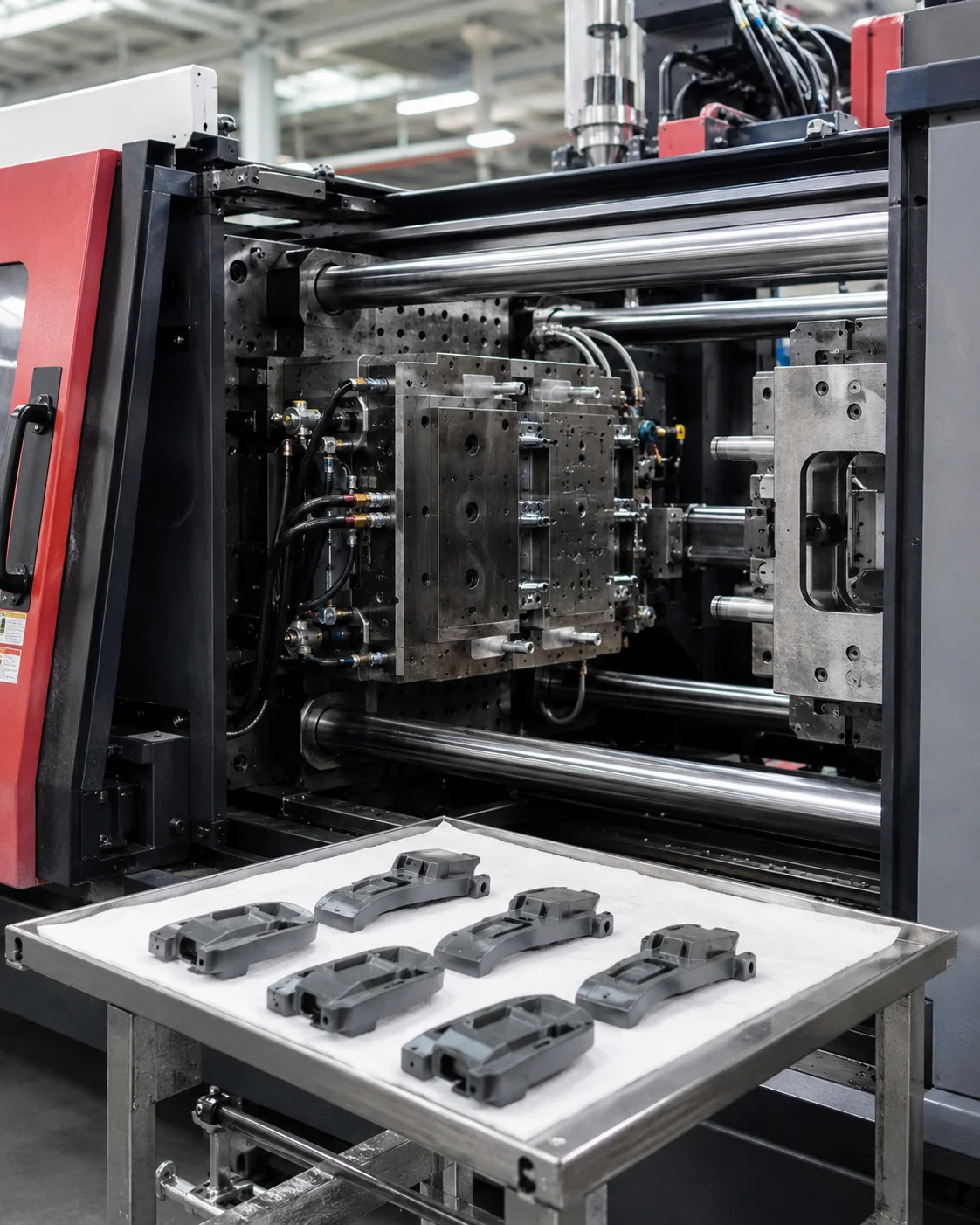
Product development rarely moves from a finished CAD model directly into a permanent production mold. Designs can change after functional testing, initial market feedback can alter expected volumes, and manufacturing locations may shift once a product reaches a more predictable stage. Under these conditions, rapid tooling China can serve a different purpose than simply producing molded samples quickly.
The more strategic role is to create a temporary but production-relevant manufacturing path. Instead of committing immediately to a dedicated long-life mold, a development team can use a faster tooling route to validate the product, establish demand, and determine what the eventual production setup should look like.
HordRT describes rapid tooling as suitable for functional prototypes, pre-production testing, bridge production, and low-volume manufacturing. Its current tooling service also separates prototype, bridge, production, and export tooling according to different production stages.
The First Mold Does Not Always Need to Be the Final Mold
A common manufacturing assumption is that tooling should be designed for the largest expected production volume from the beginning. That approach makes sense when product geometry, material, demand, and manufacturing location are already stable. Early-stage products rarely provide that level of certainty.
A rapid tool can instead support a period of controlled learning. Engineers can mold actual production-grade thermoplastics, examine fit and function, collect dimensional data, and identify design changes before a larger tooling investment is made.
HordRT lists a range of engineering plastics for its rapid tooling and molding services, including ABS, PC, PC/ABS, PP, POM, PA, PMMA, TPU, PBT, and PPS. Material selection can be matched to requirements such as mechanical performance, flexibility, dimensional stability, temperature resistance, or surface appearance. Using a material that is close to the intended production specification may also make early molded parts more useful for evaluating application-specific performance and manufacturing considerations.
That makes the first tool less of a final destination and more of a manufacturing checkpoint.
Volume Uncertainty Can Change the Tooling Decision
Forecasts often become less reliable as the product gets closer to launch. A component initially expected to require tens of thousands of units may instead remain a specialized product with modest demand. Conversely, successful validation can create demand that was not visible during engineering development.
This is where rapid tooling China can provide a middle manufacturing stage. A company does not necessarily have to choose between expensive production tooling and non-molded prototypes. A shorter-life mold can support initial production while actual demand becomes clearer.
HordRT states that rapid tooling is appropriate for functional prototypes, engineering validation, pre-production testing, bridge production, and low-volume manufacturing. The company’s FAQ also explains that production tooling becomes more appropriate when product design is stable and expected long-term volume justifies a dedicated mold.
The decision therefore becomes less about “prototype or production” and more about how much manufacturing certainty the product has earned.
Tool Ownership Becomes Important When Production Moves
One overlooked issue in temporary tooling programs is what happens when manufacturing moves later.
A development project may begin with one molding supplier and eventually transition to another factory, perhaps because production volume has increased or the customer wants manufacturing closer to its main market. A rapid tool that cannot be transferred conveniently may create a new engineering expense at precisely the moment the product is scaling.
HordRT’s published terms distinguish between customer-specific cavity and core inserts and components belonging to its shared MUD system. Once tooling costs are fully paid, the customer-specific inserts belong to the customer, while the standard shared mold base, hot sprue, and shared hydraulic components remain with HordRT. If a complete mold needs to move to another molding supplier, a dedicated mold base and related components need to be quoted separately.
That distinction changes how procurement teams should define tooling ownership. The question is not simply whether the customer owns “the mold.” Buyers should establish which physical components constitute the transferable tooling asset.
A Design Change Is Less Expensive Before the Product Stabilizes
Early production frequently exposes issues that CAD review cannot fully predict. Cosmetic expectations may change, a snap-fit may require adjustment, or an assembly interface may need additional clearance after physical testing.
A short-cycle tooling strategy can make these changes easier to absorb before a long-life mold is committed. HordRT notes that steel-safe adjustments and other practical design changes can often be incorporated after the first mold trial, with feasibility depending on the specific modification.
This does not mean every design change is inexpensive. Major geometry changes can still require substantial machining, additional steel, or even new tooling. The strategic advantage comes from keeping the initial manufacturing commitment proportional to the maturity of the design. In other words, tooling flexibility has value precisely when engineering uncertainty is still high.
Export Tooling Creates Another Transition Path
A product may eventually be molded in a different country even if its first production runs are made elsewhere. That makes export-ready tooling another possible stage in the product lifecycle.
HordRT identifies export tooling as a separate route for overseas molding and describes it as standalone tooling prepared for transfer to a nominated molding facility, with documentation and shipment arrangements.
For global product teams, this creates a useful distinction between manufacturing the first parts and establishing the permanent production location. Those two decisions do not necessarily have to happen simultaneously.
A company can validate the product and its molding requirements first, then transfer a suitable dedicated tool once the production strategy becomes clearer. That approach can reduce the pressure to finalize every supply-chain decision at the beginning of product development.
The Real Value Is the Transition Between Stages
A key application of rapid tooling in China is to support development when production requirements are still being evaluated. Its value can extend beyond speed by providing a practical step between early-stage development and more established production processes.
HordRT‘s current service structure reflects this lifecycle logic: prototype tooling supports design validation, bridge tooling addresses pre-production and initial market demand, production tooling supports repeat manufacturing, and export tooling addresses transfer to another molding facility.
Such a staged model gives engineering and procurement teams more opportunities to make decisions using real manufacturing evidence. Tool life, production quantity, material selection, design stability, and future manufacturing location can all be reconsidered as the product develops.
The practical question for a development team is therefore not whether the first mold can last forever. It is whether that mold provides the right manufacturing capability for the current stage without unnecessarily restricting the next one.
That perspective makes rapid tooling a lifecycle strategy rather than merely a faster version of conventional mold making. When the product is still proving its geometry, demand, and production path, the right tooling investment is the one that supports the next decision while keeping the following transition technically and economically manageable.