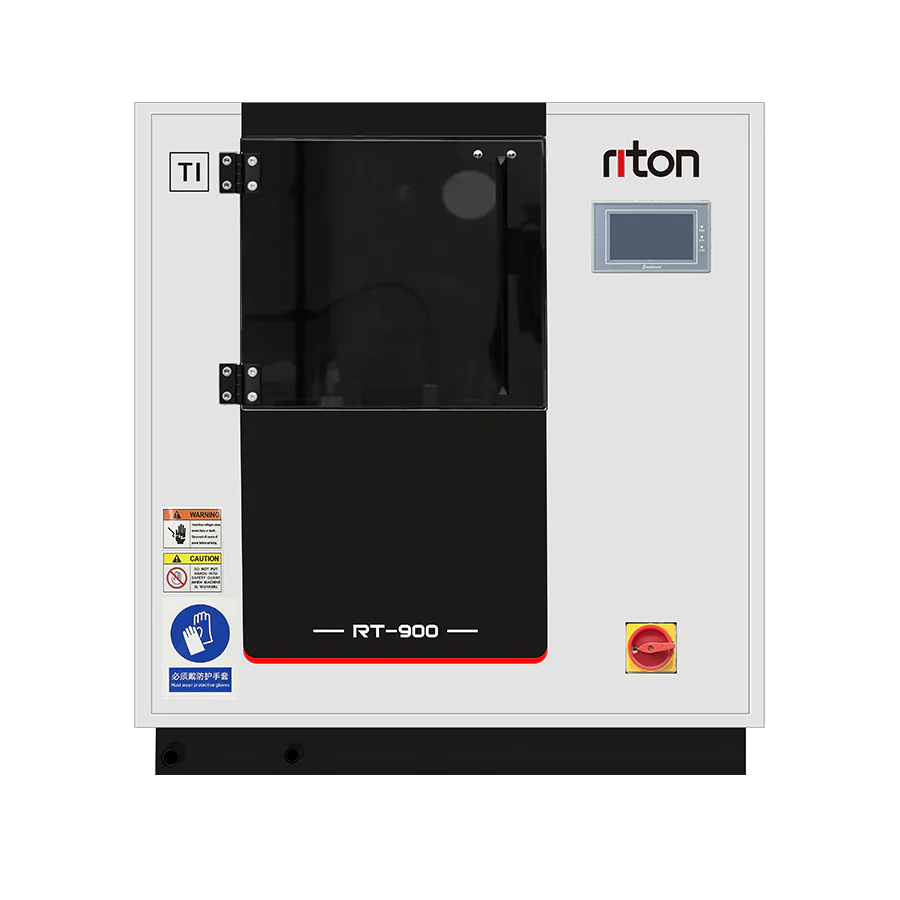
For dental laboratories and other professional additive manufacturing operations, printing is only one part of the production workflow. Surface finishing can determine whether a 3D-printed component is ready for its intended application. Metal additive manufacturing can leave rough surfaces, partially fused particles, and geometric irregularities that require post-processing. Research has shown that plasma-based polishing can significantly improve the surface quality of additively manufactured metal components, making the technology increasingly relevant to professional production.
What Is a 3D Printer Polisher?
A 3D printer polisher is post-processing equipment designed to improve the surface condition of parts produced by additive manufacturing. Depending on the technology, polishing can use mechanical abrasion, lasers, chemical processes, or electrochemical and plasma-based methods. The appropriate approach depends on the printed material, geometry, required surface finish, and production objectives.
For professional users, polishing is not simply about making a component look smoother. Surface roughness can influence functional performance, cleaning requirements, wear behavior, and the suitability of a component for its final application. Studies of additively manufactured metals have therefore examined plasma electrolytic polishing as a precision finishing method for complex components.
Why Professional 3D Print Polisher Technology Matters
Traditional manual polishing can introduce variability because results depend on operator technique, pressure, polishing time, and accessibility. This becomes particularly important when processing multiple dental components that need consistent finishing.
A professional 3D print polisher can help shift post-processing from an operator-dependent activity toward a more controlled production process. Plasma polishing is especially interesting because it can process complex metallic geometries that may be difficult to finish uniformly through conventional mechanical methods. Research has demonstrated its potential for treating intricate and porous additively manufactured structures.
How Plasma Polishing Works
Plasma electrolytic polishing generally combines electrical discharge phenomena with electrochemical material removal. During processing, a plasma or vapor-gas layer forms around the workpiece, enabling controlled removal of material from surface irregularities.
The process is different from conventional abrasive polishing because it does not rely on a polishing tool physically rubbing against every surface. Research on additively manufactured Ti-6Al-4V has reported substantial reductions in surface roughness after optimized plasma electrolytic polishing, although outcomes depend strongly on process parameters and initial surface conditions.
This distinction is important for professional applications. A finishing method must improve surface quality without compromising the functional geometry established during printing.
Key Factors When Evaluating a 3D Printer Polisher
Businesses evaluating a 3D printer polisher should look beyond headline polishing performance. Dimensional control is one important consideration, particularly for dental applications where components can contain fine features and defined edges.
Process consistency is another factor. If operators achieve noticeably different results from one batch to another, additional inspection and rework may be required. A production-oriented polishing system should therefore support repeatable processing and reduce unnecessary dependence on manual intervention.
Workflow efficiency also matters. Post-processing can become a bottleneck when printing capacity increases. Equipment that simplifies the finishing procedure can help laboratories maintain a more predictable production flow.
Riton RT-900: Plasma Polishing for Digital Dental Production
Riton, a provider of dental 3D printing solutions, includes the RT-900 Plasma Polishing Machine within its additive manufacturing equipment portfolio. Riton positions the system around digital production efficiency and reduced dependence on manual polishing. Its official resources list the RT-900 as part of its range of 3D printing and auxiliary equipment.
According to Riton’s product information, the RT-900 uses a gentle polishing process designed to remove surface roughness peaks without altering the overall dimensions or edge angles of the finished product. This focus is particularly relevant to professional dental workflows, where surface finishing needs to complement rather than undermine the accuracy achieved during printing.
The RT-900 is also designed to reduce uncertainty associated with human factors in polishing. The process enables stable polishing results and simplifies operation so that polishing can be completed in one streamlined step.
Building a More Consistent Dental 3D Printing Workflow
A professional polishing system should be considered as part of the complete manufacturing chain rather than an isolated machine. For dental laboratories, that chain may include digital design, printing, cleaning, post-processing, inspection, and final delivery.
Riton’s broader portfolio reflects this integrated approach, covering metal and resin 3D printers, materials, auxiliary equipment, and digital software platforms for dental production.
For buyers, the objective is not simply to purchase another machine. The more important question is whether the equipment can improve repeatability, reduce manual workload, and support production requirements as order volumes increase.
Making Surface Finishing Part of Production Strategy
The growing use of additive manufacturing in professional applications makes post-processing an increasingly important production consideration. A 3D print polisher can contribute to this stage by addressing surface roughness while helping manufacturers pursue greater process consistency.
Plasma polishing is not a universal solution for all printed materials and geometries, and process parameters remain important. Nevertheless, current research demonstrates its potential for precision finishing of additively manufactured metal components.
For dental businesses seeking to build a more digital and standardized workflow, Riton’s RT-900 offers an example of how dedicated plasma polishing equipment can reduce manual constraints. By combining controlled surface finishing with a simplified process, it can support the broader goal of making dental 3D printing more consistent, efficient, and production-ready.