For homeowners looking to maximise solar investment, standalone PV panels no longer suffice. The missing link is intelligent storage and control. A neutral industry observer would note that residential energy storage systems have evolved from simple backup boxes into fully integrated platforms that communicate seamlessly with solar inverters and home energy management systems (HEMS). This integration allows households to increase self-consumption, shift loads, and maintain power during outages—all managed through a single user interface.
Real-Time Coordination Between PV, Battery, and Smart Loads
Effective integration begins with a hybrid inverter or a DC-coupled battery energy storage system that shares data with the HEMS. The HEMS monitors solar generation, household consumption, battery state of charge, and grid pricing. When PV production exceeds home demand, the system automatically directs excess energy to charge the residential energy storage system. When solar fades or tariffs rise, the HEMS commands the battery to discharge for evening appliance use or EV charging. This closed-loop control eliminates manual intervention and ensures the battery operates only when economically or practically beneficial.
Commercial Principles Applied to Residential Needs
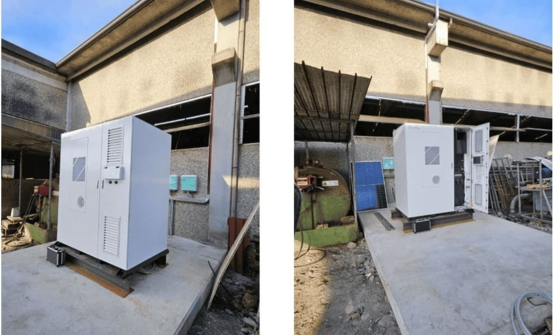
While battery energy storage systems are often discussed in utility-scale terms, the residential segment benefits from the same intelligent energy management logic. A practical illustration comes from an Italian enterprise project, though its principles apply directly to high-end homes. The solution combined a 90 kW PV system with a 200 kWh Dyness DH200F commercial & industrial energy storage system. Designed for C&I applications, the DH200F efficiently stores surplus solar energy generated during the day and releases it during peak demand periods, supporting balanced energy use. For a residence, a smaller-scale residential energy storage system performs the identical function—storing daytime solar for evening consumption and providing backup during grid faults.
Seamless Deployment and Long-Term Support
Integration is not just about hardware compatibility. Professional deployment ensures that the battery energy storage system correctly communicates with existing PV inverters and home automation platforms. Dyness provides comprehensive delivery services, including on-site installation guidance, system commissioning, grid connection, and operating parameter configuration, along with long-term after-sales technical support and warranty services. This level of service guarantees that homeowners experience true plug-and-play integration rather than persistent compatibility headaches.
Looking Ahead at Smart Home Energy
The future of residential energy storage systems lies in deeper HEMS integration—using weather forecasts to optimise charging, price signals to automate arbitrage, and load prediction to extend battery life. As Dyness demonstrates with both C&I and residential-focused solutions, the core requirement remains unchanged: seamless communication between PV, battery, and home energy controls. For any homeowner or installer evaluating battery energy storage systems, integration capability is no longer a luxury—it is the foundation of solar self-sufficiency.