Hydrogen sulfide (H₂S) monitoring is essential in industries such as oil and gas, wastewater treatment, chemical manufacturing, and mining. Choosing suitable equipment requires more than checking detection range: sampling method, alarm configuration, portability, operating time, and maintenance requirements all affect workplace safety.
RKI, GasDog, and Bosean offer different approaches. RKI’s GX-3R emphasizes compact multi-gas personal monitoring, GasDog provides dedicated H₂S detection options, and Bosean‘s K-600N combines six-gas monitoring with practical industrial features.
- What Matters When Comparing H₂S Detection Equipment?
Hydrogen sulfide is a toxic gas that can be released during industrial processing, wastewater decomposition, and petroleum operations. Because hazardous concentrations can develop quickly, workers need instruments that provide timely readings and clear warnings. An appropriate detector should match the expected concentration range, exposure risks, and conditions in which employees perform their tasks.
Detection range and resolution are two important selection criteria. A device intended for routine atmospheric monitoring may require different measurement capabilities from one used for process investigation or higher-concentration environments. Buyers should also examine response time, accuracy, alarm thresholds, sensor service life, and calibration procedures.
Sampling method matters as well. Diffusion instruments monitor surrounding air directly and are convenient for personal monitoring. Pump-sampling models draw air through a probe or tube, allowing users to investigate locations that may be difficult or unsafe to approach. These functions serve different purposes, so neither approach is automatically superior.
- RKI GX-3R: Compact Multi-Gas Personal Monitoring
RKI’s GX-3R is designed for workers who need a lightweight instrument for continuous personal monitoring. It simultaneously detects combustible gases, oxygen, carbon monoxide, and hydrogen sulfide. Weighing approximately 100 grams without its rubber boot, it is particularly suitable for applications where equipment needs to remain attached to a worker’s clothing.
Its H₂S detection range is 0–200 ppm, with a resolution of 0.1 ppm. The instrument uses diffusion sampling as standard, while an optional sampling pump provides additional flexibility. Audible, visual, and vibration alarms help communicate hazardous conditions, and its battery supports approximately 25 hours of operation.
Another consideration is its IP66/68 protection rating and three-year warranty. The model also provides TWA and STEL alarms and records calibration, bump-test, and alarm information. For companies prioritizing compact personal protection and established monitoring procedures, this design offers a focused solution.
- GasDog: Dedicated H₂S Detection and Pump Sampling
GasDog offers several hydrogen sulfide detection models, including the GD400-H2S and GD200-H2S. Unlike a conventional multi-gas instrument, these products concentrate on measuring one target gas, making them relevant when H₂S is the primary monitoring concern.
The GD400-H2S offers selectable measurement ranges of 0–50, 0–100, or 0–200 ppm. Its specifications include 1 ppm resolution, an accuracy of ±2% F.S., and a response time of no more than 30 seconds. It supports both pump suction and diffusion sampling, with an IP67 protection rating and ATEX explosion-protection certification.
The GD200-H2S provides another option for applications requiring pump-based sampling. Depending on the selected configuration, its measurement range can extend from low atmospheric concentrations to substantially higher process concentrations. The manufacturer lists a response time of no more than 10 seconds, adjustable pump suction, and optional data logging.
These features make GasDog worth considering for targeted inspection and sampling tasks. However, purchasers should confirm the exact sensor range and configuration before comparing models, since specifications vary with the selected version.
- BoseanK-600N: Six-Gas Monitoring for Industrial Applications
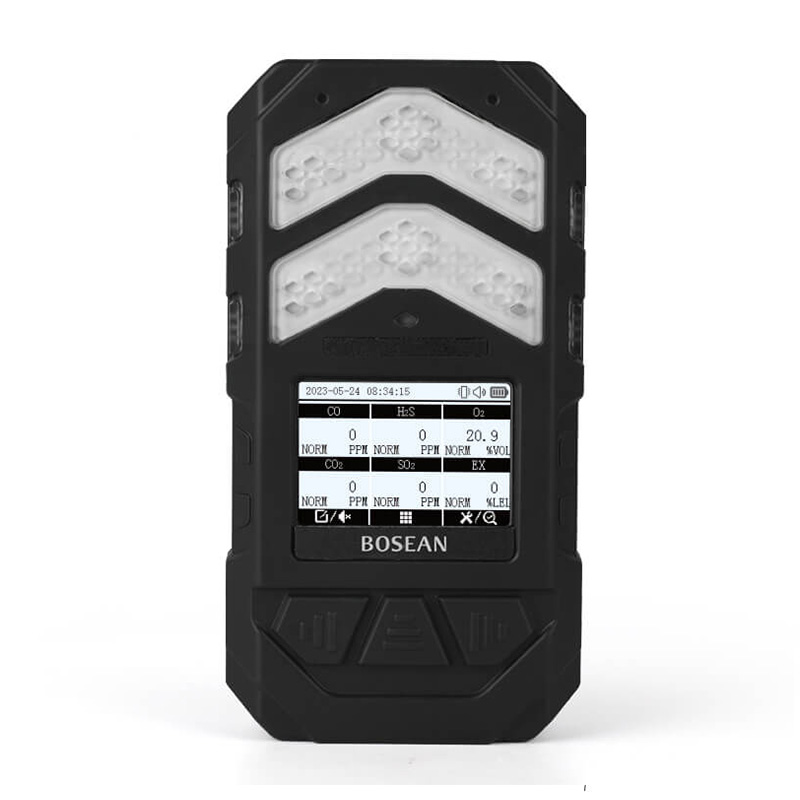
For businesses that need to monitor several atmospheric hazards simultaneously, Bosean’s K-600N offers a different approach. This instrument is designed as a portable six-gas detector, with a standard configuration covering H₂S, CO, O₂, CO₂, NO₂, and combustible gases. Its multi-parameter design can reduce the need to carry separate instruments during routine site inspections.
The K-600N features a 240 × 160-pixel dot-matrix display and a three-button interface, making its operating controls relatively straightforward. For industrial teams, the four alarm methods are particularly relevant: sound, light, vibration, and on-screen indication. The detector supports multi-point calibration of up to five points and computer-based data reading through a Type-C USB connection. Its rechargeable 1,800 mAh battery provides at least eight hours of continuous operation under the specified non-alarm conditions.
As a practical 6 gas monitor, the K-600N is suited to organizations that want to observe multiple gas hazards with one handheld device. Its IP66 protection rating and Ex ia IIC T4 Ga explosion-protection classification are additional specification points buyers should assess against their site requirements.
- How Should Businesses Choose Between These Models?
The three products address different monitoring priorities rather than representing directly interchangeable alternatives. RKI’s GX-3R is a strong candidate for lightweight personal monitoring, particularly where longer battery operation and detailed exposure alarms matter. GasDog’s dedicated instruments are relevant when H₂S measurement is the main requirement, especially when pump sampling or extended measurement ranges are needed.
Bosean’s K-600N is more appropriate when several gases must be monitored together during industrial inspections. As a 6 gas monitor, it combines H₂S measurement with oxygen, combustible gas, and other toxic-gas detection options. Nevertheless, its standard H₂S range is narrower than some available GasDog configurations and the RKI GX-3R range.
Before purchasing an H₂S tester, safety managers should compare the required measurement range, sampling arrangement, alarm thresholds, certification, data management, and maintenance support. They should also verify whether the selected configuration meets applicable workplace regulations and site-specific risk assessments.
Making a Practical Investment in Gas Detection
Selecting an H₂S tester is ultimately a matter of matching instrument capabilities to operational hazards. RKI provides a compact personal-monitoring option, GasDog offers dedicated H₂S instruments with flexible sampling configurations, and Bosean supplies a multi-gas alternative for broader inspection requirements.
For procurement teams, the best decision comes from evaluating actual working conditions, calibration needs, and total ownership costs rather than relying on brand comparisons alone. As a manufacturer and supplier of gas detection and measurement instruments, Bosean also provides technical services to help customers identify equipment configurations suited to their applications. A carefully selected detector, supported by regular testing and proper training, contributes to a more reliable workplace safety program.