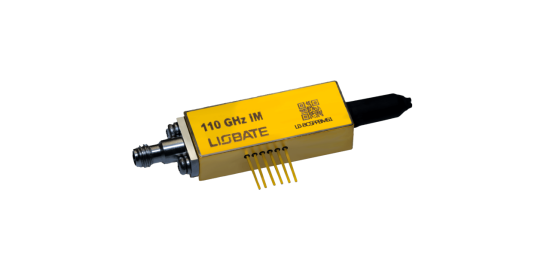
Intensity modulation converts optical carriers into controllable light power profiles, enabling applications such as high-speed communication, precision test signals, and scalable system architectures. As network demands grow, engineers look for modulators that deliver strong RF bandwidth while maintaining efficient drive requirements. That balance supports compact designs and helps reduce power consumption across optical front ends.
How TFLN Liobate Devices Support Intensity Modulation
Liobate presents TFLN devices designed for intensity modulation with practical performance targets. The product lineup includes 67/110 GHz intensity modulators and 20/40 GHz intensity modulators. These devices focus on bandwidth and drive efficiency to support faster signal generation without requiring excessive voltage.
For example, the 67/110 GHz intensity modulator is specified with 3 dB bandwidth at 67/110 GHz, insertion loss under 4.5 dB, and half-wave voltage under 3.0 V. This combination supports efficient operation when system designers need high-speed intensity control.
Key Performance Highlights to Consider
In many deployments, designers care about both signal quality and operational cost. Lower insertion loss supports stronger optical output, helping receivers maintain sensitivity. Lower half-wave voltage supports lower-power drive electronics, which can simplify system integration. Liobate’s 20/40 GHz intensity modulator is specified with 3 dB bandwidth around 40 GHz, insertion loss under 4.5 dB, and half-wave voltage under 3.0 V, aligning well with demanding bandwidth plans.
Liobate also offers a 20/40 GHz intensity modulator with a built-in LD. It combines a compact approach with integrated low-RIN light sourcing, and the ON-state output optical power is specified at 12 dBm. This can reduce external components in systems that benefit from stable light sources.
Conclusion
The future of low-power, high-bandwidth intensity modulators is closely tied to efficient electro-optic design, manageable insertion loss, and drive voltages that fit real system constraints. With Liobate TFLN devices, engineers can explore intensity modulator options that match high-frequency requirements while supporting practical, energy-aware system design.